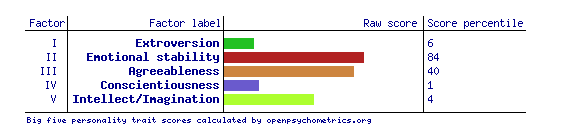
I think I'll wait for a few months before taking those tests again. I am probably right to say there won't be much use in the data until things are stable.
6:24 AM
I wish I had the last one though. I really am interested to see what happens to the "emotional stability" trait for cards and I compared to the data from a while back. I wonder if they will change in similar ways or even opposite ways.
For example, I know someone for whom switching is not done completely, the host is in the background of everything and even influences the one supposedly controlling the body with thoughts, emotions, and reactions. This could mean that even when the tulpa is in front, they will have the emotional stability trait altered if they don't have exactly the same reactions to perceptively negative events as their host.
It can even alter decision making. It is likely that such cases could conceivably alter every single personality trait as far as how they end up acting things out in the presence of the host's influence.
Well most tulpas aren't only conscious in terms of controlling their body. They normally have an idea of who they are in the state of no influence and would likely even struggle to envision the instances where they are dealing with the influence of their host to test the resulting trait scores of the "result personality" made by being both in control and having injected subjective experiences.
6:34 AM
it is likely some may never get to be themselves and share meaningful physical interaction with others.
Err, no. I would argue that if they cannot show this behavior to other people, then it is irrelevant.
6:36 AM
If I tell someone that Angel is actually agreeable and rather kind, but they never see it, it will not matter. She will not be treated and perceived in this way.
I believe that even falls more in line of a curiosity in agreement with what I'm saying. For example, most tulpas would not test accurately under the hypothetical situation of having the influences of their host, they would test for their ideal selves if they were unencumbered, as that is most likely the most familiar situation by which they truly know themselves.
6:39 AM
The host-influence would kind of invalidate their tests, with practically no way to mediate this or control for it.
If people are claiming this, they only have a moody tulpa, not one with bipolar disorder.
6:42 AM
So, please do not insult people with actual mental disorder by behaving as if it is a personality trait. Personality traits can be changed and influence be changing behavior. Mental disorders cannot.
If a person acts as though they are bipolar yet there are other personalities that are free of these symptoms, then the person cannot be truly afflicted with bipolar disorder due to the fact that it is clearly limited purely to the personality and therefore the behavior is a result of personality traits, reactions, maybe even experiences. Personalities always have some capacity to change, adapt, and improve. The differences between the personalities in a single system demonstrates the degree to which each personality is capable of changing and developing over time.
This discounts the actual experiences of the mentally ill, a group of people with a large stigma already. It says that they can change this disorder because it is a personality trait. People already act this way to people and it is insulting.
Not the maximum degree, but simply an example of potential personalities that are stable in the host brain. So the "bipolar" personality is inherently capable of eliminating that aspect of themselves without chemical intervention.
It does not mean that a personality can't suffer or have challenges specific to themselves. Rather, it is an encouraging message that they can have the opportunity to become a much better version of themselves. This is critical to maintaining mental health.
You are educated in this, Harleen, do you know if there are disorders specific to personality? As in, not a result of something emerging from chemistry or---
It really is my pet peeve for people in the tulpa community to behave in a way that implies mental disorders that are chemical imbalances are personality traits, though.
6:51 AM
So, I do apologize if I came off as aggressive, but it feels personally insulting to me.
I am afraid it might not be true that it is a disorder that is limited to personality. Unfortunately, flashbacks and panic occurred at rather consistent intervals, even though I have had a much more negative experience with it due to greater degree of not wanting to have them.
6:53 AM
When Cards came to put the disorder away for good, I believe there may have been some small residual fears in my memory afterwards, however the real symptoms vanished at the same time for both of us.
6:53 AM
I will not be in any rush to determine this through further self-testing.
I know anxiety symptoms are different between personalities, and that even unconscious symptoms can return after being eliminated due to exposure therapy.
A lot of the tests I could construct require me to have a willing participant and it would be a rather painful process, but I would do it for science and document if I ever come across the opportunity.
Some mental issues are like that, @Jas - both caused by and a cause of chemical imbalances (though, to be clear, those chemical imbalances typically are merely reinforcing the mental issue).
From my understanding, you can have chemicals in your brain that are low, serotonin I believe, and that is a risk factor for developing anxiety, but not the direct cause.
Oh I'm sure you know, it's one of the hard-to-describe ones, uhhh, uncontrollably flinching to the touch
7:09 AM
It's very, very easy to document and identify, and very easy to record when it abates after continued exposure therapy.
7:10 AM
It also returns if there has been absolutely no exposure for extended periods of time.
7:11 AM
And I don't think the exposure gives general results, so it would be limited to the person participating in the test for more consistency. I would test if exposure effectively removes the symptom for both me and my host or if it only removes it for one.
It applies to all touch from any source. Even someone presumably in high trust and closeness, even with years-long history of physical intimacy, if there is a period of time where there is no interaction that qualifies as being touched on the affected zones, it will be present.
It may take at most 3 months of no qualifying contact for the symptom to return.
7:16 AM
Right, but I don't see where it comes in for the case of the person being otherwise completely comfortable with a history of such or similar interaction.
It may be the case that anxiety is present yet ignored thoroughly enough that it goes unnoticed as a psychological symptom, and only after the surprise of an uncontrolled strong muscle contraction reflex would one wonder if perhaps there may be something amiss.
7:21 AM
It would be, I suppose, in the case of someone who is so regularly afflicted that they forget it is even unusual and regulate themselves under that as the status quo.